
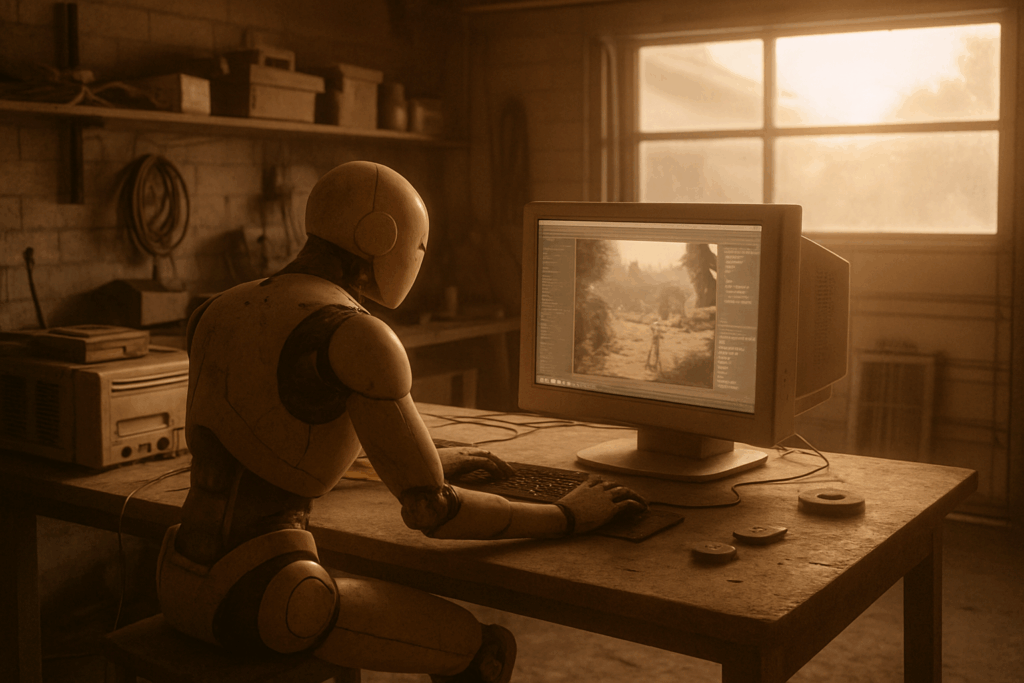
Smarter Games from the Ground Up
In 2026, artificial intelligence (AI) and machine learning (ML) are no longer experimental or auxiliary they are foundational technologies embedded in the entire game development lifecycle.
AI as a Core Development Tool
Gone are the days when AI was limited to basic enemy behavior or scripted responses. Today, AI plays an integral role from day one of development:
Procedural World Generation: Massive game worlds can now be generated faster and with more variation, using AI to ensure logical architecture, environmental storytelling, and playability.
Real Time Testing and QA: AI algorithms assist in automated bug detection and simulation testing, speeding up quality assurance workflows.
Dynamic Balancing: AI analyzes thousands of gameplay sessions, helping to auto tune mechanics so that difficulty and pacing stay optimal.
Quality and Scale Go Hand in Hand
With these tools, studios can produce games that are not only larger in scale but higher in quality:
Consistent Player Experiences: AI helps ensure consistency in physics, behavior, and design, even across open world and sandbox style games.
Accelerated Production Timelines: Machine learning models offload repetitive and time consuming tasks, allowing developers to focus more on design and creativity.
A Strategic Investment for Every Studio
Both indie teams and AAA powerhouses are adapting. Why?
Cost Efficiency: With smart AI pipelines, smaller teams can produce content at a level that rivals larger studios.
Customization at Scale: AI allows for player specific game experiences, which helps with retention, replayability, and monetization.
Staying Competitive: As the industry standard evolves, integrating AI isn’t optional it’s a requirement for staying relevant.
AI and ML are now fundamental to building better, smarter games. Developers who embrace these tools are setting the pace for the industry’s future.
Game Worlds That Think for Themselves
The days of static, predictable NPCs are numbered. In 2026, AI is driving non player characters that actually learn from the way you play. Whether you’re aggressive, stealthy, or chaotic, NPCs can now shift their behavior accordingly altering strategies, dialogue, or even forming alliances based on your patterns. It’s not just reactive; it’s adaptive.
Storytelling is also bending to player influence. Branching narratives aren’t new, but what’s different now is how they’re reconstructed on the fly. Generative AI tools are letting devs build modular story elements that update and respond to in the moment actions. One decision early on might unravel a whole new storyline hours later not because it was pre written, but because the system stitched something new together.
Then there’s the environment. With emotional and behavioral input from players ranging from voice inflection to movement speed game worlds can change tone in real time. Lighting shifts. Music adjusts. NPC reactions recalibrate. It feels like the world is not just aware of you, but sensing you. And it’s turning games into something closer to personalized, living experiences.
The result: playthroughs that don’t just feel different they are different. Unique to each player. Built on the fly. And powered by adaptive systems that are finally catching up to imagination.
Machine Learning in Game Design
Player behavior is now the blueprint. Developers aren’t guessing where players struggle or quit they’re learning from raw gameplay data. Every missed jump, abandoned quest, or rage quit gets logged and analyzed. From there, machine learning models adjust difficulty spikes, tweak tutorial pacing, and reshape how progression flows. Games are tuning themselves in real time.
A/B testing has also gone full throttle. What used to take months of post launch patching, forums, and gut instinct now happens in weeks or even days. Studios test multiple versions of a mechanic whether it’s enemy AI or reward timing and let the data decide the winner.
More critically, ML is helping identify where players lose interest entirely. Drop off analysis has evolved. It’s not just about knowing when a player logs off it’s about understanding the friction that led them there. Is a level grindy? Does the narrative stall? These are the questions ML systems are answering, and fast.
For designers, this shift means tighter feedback loops and smarter iteration. It’s not about guessing anymore. It’s about learning and adapting in real time right alongside your audience.
AI Behind the Curtain: Tools for Developers

Developers no longer wrestle with every detail. Generative AI has taken over the grunt work creating textures, audio, character dialogue, and animations faster than most teams could delegate. Instead of designing background assets one by one, creators sketch a prompt and let the model handle ten variations in seconds. It’s not just about speed it’s about freeing up human attention for decisions that actually matter.
Machine learning is also making quality control smarter. Automated bug reporting and AI assisted QA tools spot issues as they’re coded, not weeks later in testing sprints. Glitches, logic breaks, and balance problems are flagged early, often with suggested fixes. That’s cutting entire cycles out of development timelines.
The environment these games are built in? It’s evolving too. Smarter IDEs (integrated development environments) now lean on AI to optimize code on the fly, flag performance issues, even recommend changes to maintain game balance. You’re not working alone anymore the tools are thinking with you, catching mistakes before they cost you weeks.
These changes don’t just accelerate development. They change who’s able to develop in the first place. With fewer technical blockers, smaller teams can punch above their weight. That’s good for innovation, and even better for the games we’re all itching to play.
Compatibility with Engines and Workflows
The tools powering AI infused game development are evolving just as fast as the games themselves. By 2026, AI isn’t just a plugin it’s a foundational part of most development pipelines, baked into workflows from prototype to post launch support.
AI Integration: The New Industry Standard
Most modern game dev environments come with AI features pre integrated
AI workflows are no longer reserved for AAA studios they’re accessible for indie teams too
Whether used for procedural generation or real time balancing, AI is now a default layer in production
Unity, Unreal & Beyond
Game engines are keeping pace with developer demands:
Unity: Now includes native support for ML agents, procedural animation tools, and real time analytics for gameplay tuning
Unreal Engine: Offers deep integration with AI behavior trees, environmental queries, and dynamic storytelling frameworks
Both engines support plug and play AI assets and cloud based model training to enable faster iteration
Resource for Game Teams
For a breakdown of how Unity and Unreal compare in their AI capabilities, check out:
Here’s a closer look at game engines powering AI driven futures
What’s Next for AI in Games
AI isn’t just shaping how games are made it’s shaping how they play. Reinforcement learning is now being used to build enemies, puzzles, and levels that adapt to each player’s skill level. The days of flat, one size fits all difficulty are fading. These systems watch how you move, where you struggle, how you win and they adjust. That means seasoned players can finally encounter a challenge that evolves with them, while newcomers aren’t overwhelmed five minutes in.
On another front, emotion aware gameplay is inching into reality. Using facial recognition, voice analysis, and even physiological sensors, games are starting to pick up on how you feel. If you’re showing signs of frustration, the level might ease up. Feeling bored? The pace picks up. It’s subtle, but it reimagines immersion at a whole new level.
But with all this power comes risk. These models collect data lots of it. Player behavior, emotional responses, biometric inputs. The ethics of how that data is stored, used, and protected is still foggy at best. And then there’s the elephant in the room: automation. As AI gets better at designing and optimizing, human roles especially in QA, level design, even narrative scripting could be on the line.
For now, the tools are levers. They amplify smart design, they don’t replace it. But as we hand over more creative control to algorithms, developers and players alike will need to stay sharp and stay aware.
Final Thought
Game development in 2026 isn’t led by gut instinct alone anymore. It’s a craft shaped by data, steered by models, and constantly optimized through learning systems that evolve alongside players. Every asset whether it’s a texture, a voice line, or a level layout is part of a broader feedback loop driven by artificial intelligence. Creativity still matters, more than ever, but it’s now woven tightly with machine precision tools.
If you’re a developer and you’re not leveraging AI, you’re already behind. Simple as that. Teams that understand how to train models, clean data, and apply adaptive systems to storytelling, gameplay, and testing have a clear edge. They build faster, smarter, and with less waste. Mastering AI isn’t optional anymore it’s the new baseline.
This isn’t about machines taking over. It’s about using machines to go further, faster, and with fewer blind spots. The frontier is here. Time to suit up.

 Ask Josefa Terrybit how they got into latest gaming news and you'll probably get a longer answer than you expected. The short version: Josefa started doing it, got genuinely hooked, and at some point realized they had accumulated enough hard-won knowledge that it would be a waste not to share it. So they started writing.
What makes Josefa worth reading is that they skips the obvious stuff. Nobody needs another surface-level take on Latest Gaming News, Esports Highlights, Player Strategy Guides. What readers actually want is the nuance — the part that only becomes clear after you've made a few mistakes and figured out why. That's the territory Josefa operates in. The writing is direct, occasionally blunt, and always built around what's actually true rather than what sounds good in an article. They has little patience for filler, which means they's pieces tend to be denser with real information than the average post on the same subject.
Josefa doesn't write to impress anyone. They writes because they has things to say that they genuinely thinks people should hear. That motivation — basic as it sounds — produces something noticeably different from content written for clicks or word count. Readers pick up on it. The comments on Josefa's work tend to reflect that.
Ask Josefa Terrybit how they got into latest gaming news and you'll probably get a longer answer than you expected. The short version: Josefa started doing it, got genuinely hooked, and at some point realized they had accumulated enough hard-won knowledge that it would be a waste not to share it. So they started writing.
What makes Josefa worth reading is that they skips the obvious stuff. Nobody needs another surface-level take on Latest Gaming News, Esports Highlights, Player Strategy Guides. What readers actually want is the nuance — the part that only becomes clear after you've made a few mistakes and figured out why. That's the territory Josefa operates in. The writing is direct, occasionally blunt, and always built around what's actually true rather than what sounds good in an article. They has little patience for filler, which means they's pieces tend to be denser with real information than the average post on the same subject.
Josefa doesn't write to impress anyone. They writes because they has things to say that they genuinely thinks people should hear. That motivation — basic as it sounds — produces something noticeably different from content written for clicks or word count. Readers pick up on it. The comments on Josefa's work tend to reflect that.